
The automotive industry is changing at a pace that many people simply did not expect. As someone deeply involved in the digital world of car sales — building dealer websites, managing stock, and understanding how customers search — I’ve always been fascinated by how technology shapes buying behaviour. Recently, I ran a practical experiment using AI (ChatGPT) to research real cars online, and the results were eye-opening. What started as a simple question — “Can AI search for a car online?†— turned into a deeper reflection on how artificial intelligence will completely reshape how people find, compare, and buy cars.
This blog is a reflective look at what I learned, what surprised me, and what this means for both consumers and car dealers. And if you are a dealer reading this, you might find the future not only exciting but full of opportunity.
If you are looking for a modern, fully responsive, and AI-ready car dealer website, you can check https://cardealerswebsites.co.uk, where we help dealerships stay ahead of these industry shifts.
1. How the Experiment Started
The discussion began with a simple curiosity: Can ChatGPT actually search for products on the internet and compare prices? We’ve all seen newer AI features advertised, including some that claim to help find the “cheapest products online.†But this raised a bigger question for me: What about used cars?
Cars are not like trainers or headphones — they vary in condition, mileage, spec, and dealer reputation. Searching for a car often involves manually opening website after website, filtering through endless listings, and checking whether a vehicle even exists. I wanted to explore whether AI could bypass this slow manual process.
So I asked:
“Can you find me a 2020 VW Golf diesel?â€
The AI explained how it works — using real-time web search integration to pull data from public websites, compare listings, and summarise the results. This made me realise that AI doesn’t magically access private dealer systems or Auto Trader back-end tools; instead, it uses open web pages and publicly available listings.
The important thing here is the method. The AI essentially performs the parts of the search that most buyers dislike:
- gathering listings
- comparing prices
- filtering by year, fuel type, and condition
- providing a shortlist
This alone could shave hours off the typical car-buying journey.
2. Testing AI on a Real Vehicle Search
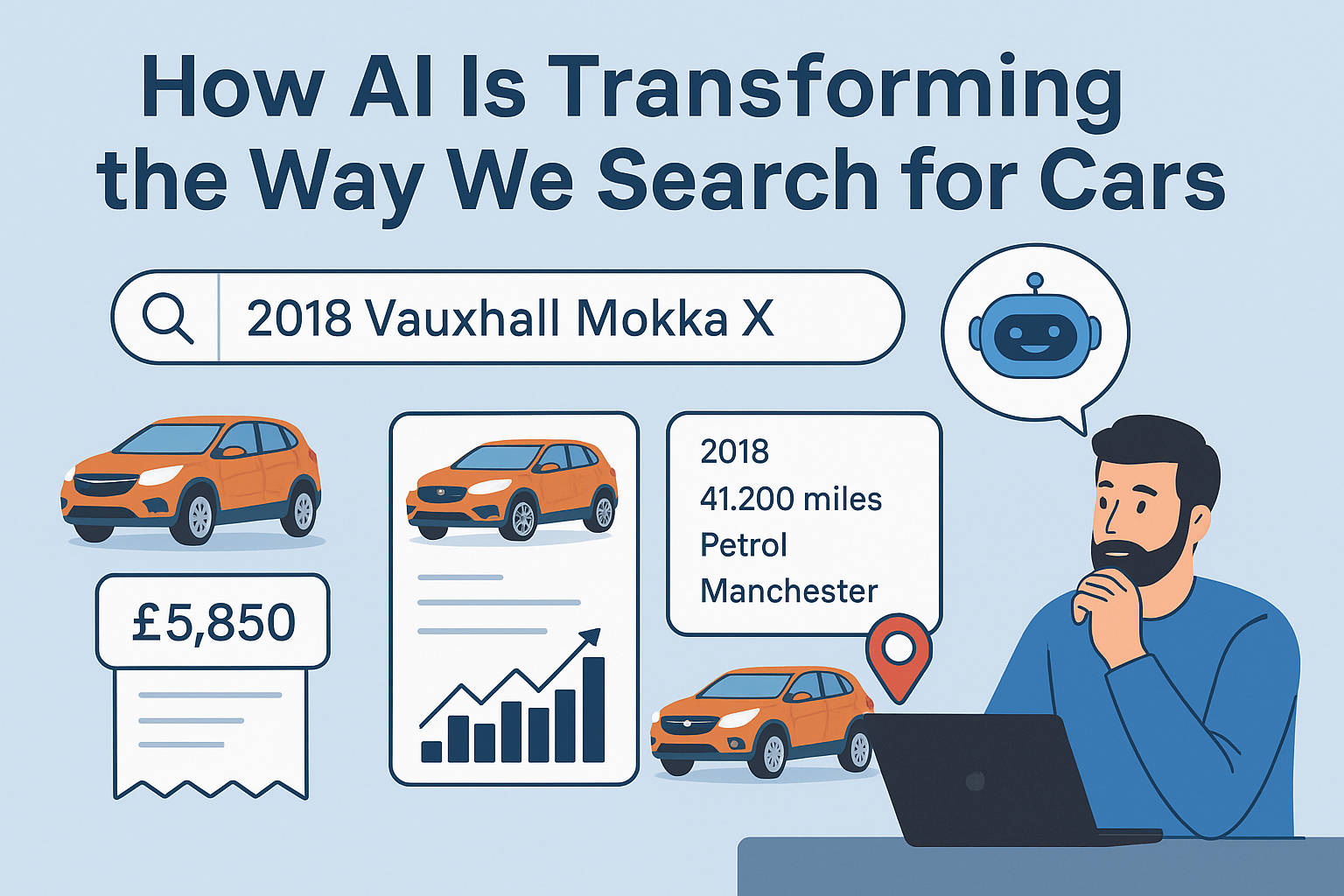
To push the experiment further, I asked the AI to search for a 2018 Vauxhall Mokka X — a popular and widely available vehicle in the UK market. This was a perfect test, because thousands of listings exist, giving AI plenty of data to work with.
The AI searched multiple websites, including well-known platforms like Auto Trader and dealer-specific websites. It quickly came back with results such as:
- Listings starting around £5,850
- Typical prices between £7,400 and £9,900
- Examples from national dealers with real links to stock pages
From my perspective as someone working with car dealers daily, this was impressive. Normally, to produce the same results manually, I’d have to search multiple platforms, filter various criteria, open each vehicle page, and record prices. The AI did it in seconds.
But beyond convenience, the experiment revealed important insights about how customers will search for cars in the future.
3. Reflection: What This Means for the Car-Buying Experience
As I reflected on the process, a few key thoughts came to mind:
➤ AI removes “search fatigueâ€
Most car buyers feel overwhelmed after browsing 5–10 websites. AI solves this by aggregating everything instantly.
➤ It eliminates the guesswork
Instead of wondering:
- Is this a good price?
- Is there a cheaper one nearby?
- Is this model commonly available?
AI can compare prices across the market and show the range within seconds.
➤ It changes the role of the dealer
Dealers have always relied on visibility — appearing on more platforms gives more exposure. But AI levels the playing field. A small dealer with a single website can gain the same visibility as a large dealership as long as the stock is indexed online.
This means having a proper, SEO-friendly dealer website is more important than ever, which is exactly what we provide at
👉 https://cardealerswebsites.co.uk
➤ Customers will expect “curated optionsâ€
Instead of browsing manually, buyers will soon expect AI to present them with:
- the 3 cheapest cars
- the 3 best-value cars
- the cars nearest to their postcode
- cars with certain features (heated seats, sunroof, automatic, etc.)
The AI can do all of this in seconds. This changes customer expectations completely.
4. AI Doesn’t Replace Dealerships — It Changes Their Visibility
One of the biggest reflections I had after this experiment is that AI isn’t designed to replace car dealers… but it will replace poor websites.
A dealership with:
- no website,
- a slow website,
- outdated stock,
- or no structured data
…will get ignored by AI tools.
Why?
Because AI relies on reading public pages and understanding information.
Dealers who invest in fast, structured, Google-friendly websites will benefit the most. AI will pick up their stock first because it’s easy to understand, easy to crawl, and clearly organised.
This is exactly what our dealer websites are built for — fast loading, SEO-optimised, and compatible with how AI reads the web. You can see all our features here:
👉 https://cardealerswebsites.co.uk
5. How AI Will Change Future Car Searches (My Predictions)
Based on the experiment and reflection, here are the changes I believe we will see:
1. Customers will stop visiting car-listing websites one by one
Instead, they’ll ask AI:
“Find me the cheapest Audi A3 within 50 miles.â€
And AI will do the browsing for them.
2. AI will compare prices automatically
It will show:
- minimum price
- maximum price
- good-value examples
- overpriced examples
This will force dealers to stay more competitive on pricing.
3. AI will understand individual preferences
If someone searches often for diesel cars under £6,000, AI will automatically shortlist relevant stock.
4. Car-buying will become more personalised
People will start saying things like:
“Find me something cheap to insure.â€
“Find me a family car under 60k miles.â€
“Find me something similar to my previous car.â€
AI can interpret all of this far better than search engines.
5. Dealer websites must adapt
Dealers who do not invest in:
- fast websites
- structured data
- mobile optimisation
- SEO
…will disappear from AI search results.
This is why more dealers will need professional websites from services like ours — built to meet the standards of modern AI-based search.
6. Reflection on the Experiment: What Surprised Me Most
Looking back, the most surprising aspects were:
âž¡ AI can detect real listings in real time
This means AI is not using old cached data — it actually searches the web.
âž¡ It combines listings from multiple sources instantly
Something that even Google doesn’t do very efficiently.
âž¡ It can highlight price ranges
This makes valuation more transparent for buyers and sellers.
âž¡ It speeds up decision-making
A buyer could realistically find a car within 5 minutes using AI.
âž¡ It reduces human error
No more forgetting to check a platform or missing a cheaper listing.
âž¡ Dealers can benefit if they prepare properly
Dealers who update stock regularly and maintain high-quality sites will appear more in AI-driven searches.
As I allowed myself time to reflect on the whole process, I realised this is not just a tool — it’s a shift in how car buyers behave.
7. What This Means for Car Dealers Right Now
Dealers must take the rise of AI seriously. The websites that AI can understand easily will gain the most visibility. Buyers will soon stop scrolling through dozens of ads and rely on AI to bring the best deals to them.
This means:
✔ Dealers need better websites
Not outdated designs — but modern, responsive, structured sites.
✔ Stock must always be updated
AI can spot outdated listings and ignore them.
✔ Pricing must be competitive
AI will highlight overpriced cars instantly.
✔ Information must be clear
The AI reads:
- price
- mileage
- year
- fuel type
- transmission
- location
If your website hides this or formats it incorrectly, AI cannot use it.
This is why platforms like:
👉 https://cardealerswebsites.co.uk
are becoming essential, not optional.
8. Final Reflection: AI Is the New “Car Search Assistantâ€
After completing this experiment, I’m convinced of one thing:
AI will become the default way people search for cars.
Not because it’s replacing dealers.
Not because it’s replacing websites.
But because it makes the process:
- faster
- smarter
- more personalised
- more efficient
It takes away the tedious part of searching and gives buyers exactly what they want. At the same time, it rewards dealers who stay modern and penalises those who don’t adapt.
From my perspective, working daily with dealers, this future is not something to fear but something to prepare for. Dealers who invest in good websites, accurate stock feeds, and transparent data will thrive in the AI era.
And for buyers, this means easier, faster, and smarter car shopping.
If you’re a dealer — prepare for the AI era now
If you want a modern dealership website that is:
- AI-friendly
- fast
- SEO-optimised
- mobile-adaptive
- easy to manage
- built for the future
You can get one at:
👉 https://cardealerswebsites.co.uk